Date: 10/8/26 11:52 am From: Paul Miller <paulbug.2876...> Subject: [MBBIRDS] Clark's Nutcrackers etc
A few birders and I saw a couple CLARK'S NUTCRACKERS today up at Loma Prieta. Sorry, don't know all the last names... Ann, Tasha, and I went before sunrise, but ended up seeing them later at around 1015. They flew overhead, silent, around here: https://maps.app.goo.gl/pQnhtF3u9fnY2ATn8?g_st=ac We also saw Dave L. and Alex later in the morning, and they saw the same birds overhead just a moment later, since they were further down the road. We saw 2; they saw 3 apparently. We also had 2 likely CASSIN'S FINCHES, heard only, near the coffee berry location, further east. Possible flyovers, or maybe just skulky. Not seen. A Merlin was doing the rounds overhead near the first Mayman's flat road, and a Peregrine was cruising overhead just a bit further west, later in the morning. Lots of good looks at Sooty Fox Sparrow. Paul Miller Mount Hermon
Date: 10/8/26 10:50 am From: Ryan Phillips <norcalbirding...> Subject: [MBBIRDS] Re: West Cliff?
Since everyone is asking, the West Cliff frenzy ended yesterday morning and
now has moved over to Sunny Cove and 20th Ave area yesterday.
Yesterday off the wharf I had multiple jaegers, one right over the end of
the wharf and of course the Black-vented Shearwater shoe and many very
close to the wharf. Also had a Pacific and Common Loon. And the number of
Common Murres was impressive.
Thanks to everyone that responded yesterday.
Ryan
*Ryan Phillips* ǀ Owner and Guide
Personal and Group Birding Excursions in Northern California and Beyond
"Everyone likes birds. What wild creature is more accessible to our eyes
and ears, as close to us and everyone in the world, as universal as a bird?"
- Sir David Attenborough
On Wed, Oct 7, 2026, 1:11 PM Ryan Phillips <norcalbirding...> wrote:
> Is the feeding frenzy still present on West Cliff in Santa Cruz?
> Any info would be appreciated. You can email/message me back privately not
> to plug this list serve up.
> Thanks,
> Ryan
>
> *Ryan Phillips* ǀ Owner and Guide
>
> Personal and Group Birding Excursions in Northern California and Beyond
>
>
>
> Phone ǀ (831) 234-7324
>
> Email ǀ <norcalbirding...>
>
> Website ǀ *www.norcalbirding.com <http://www.norcalbirding.com/>* >
> Facebook ǀ www.facebook.com/norcalbirding
>
> "Everyone likes birds. What wild creature is more accessible to our eyes
> and ears, as close to us and everyone in the world, as universal as a bird?"
>
> - Sir David Attenborough
>
>
>
>
>
Date: 10/7/26 1:11 pm From: Ryan Phillips <norcalbirding...> Subject: [MBBIRDS] West Cliff?
Is the feeding frenzy still present on West Cliff in Santa Cruz?
Any info would be appreciated. You can email/message me back privately not
to plug this list serve up.
Thanks,
Ryan
*Ryan Phillips* ǀ Owner and Guide
Personal and Group Birding Excursions in Northern California and Beyond
Here is a BOC (sorry don't have time to process tonight) from today of one
of them 30 feet from IT's. Beach. The other had a "pied" wing but body was
pretty normal.
*Ryan Phillips* ǀ Owner and Guide
Personal and Group Birding Excursions in Northern California and Beyond
"Everyone likes birds. What wild creature is more accessible to our eyes
and ears, as close to us and everyone in the world, as universal as a bird?"
- Sir David Attenborough
On Tue, Oct 6, 2026, 8:50 PM Abram Fleishman <abfleishman...> wrote:
> Alex spotted one from the water the other day. Here is my pic.
>
>
> -Abram
>
> Sent from my phone
>
> On Tue, Oct 6, 2026 at 19:51 Ryan Phillips <norcalbirding...>
> wrote:
>
>> Yes, there were two of them.in the chaos.
>>
>> *Ryan Phillips* ǀ Owner and Guide
>>
>> Personal and Group Birding Excursions in Northern California and Beyond
>>
>>
>>
>> Phone ǀ (831) 234-7324
>>
>> Email ǀ <norcalbirding...>
>>
>> Website ǀ *www.norcalbirding.com <http://www.norcalbirding.com/>* >>
>> Facebook ǀ www.facebook.com/norcalbirding
>>
>> "Everyone likes birds. What wild creature is more accessible to our eyes
>> and ears, as close to us and everyone in the world, as universal as a bird?"
>>
>> - Sir David Attenborough
>>
>>
>>
>>
>>
>> On Tue, Oct 6, 2026, 7:46 PM 'Pete Sole' via mbbirds <
>> <mbbirds...> wrote:
>>
>>> Hi birders,
>>>
>>> Reviewing my bird images from the SC lighthouse today, I came across a
>>> photo with what looks like a LEUCISTIC BLACK-VENTED SHEARWATER. Can't
>>> say I've seen one of these before. Here is a crop of the frame in
>>> question, with a red arrow pointing to the interesting bird, flying
>>> below and to the left of the elegant tern:
>>>
>>>
>>> https://www.lighthousenet.com/photos/birds/documentary/shearwater_black_vented_leucistic_261006a.jpg >>>
>>> If somebody has a different opinion as to what this bird might be, or
>>> can confirm my ID suspicion, it would be great to read.
>>>
>>> Interesting birds out there...
>>>
>>> Pete Solé
>>>
>>>
>>> --
>>> You received this message because you are subscribed to the Google
>>> Groups "mbbirds" group.
>>> To unsubscribe from this group and stop receiving emails from it, send
>>> an email to mbbirds+<unsubscribe...>
>>> To view this discussion visit
>>> https://groups.google.com/d/msgid/mbbirds/<cec76ab9-9916-4561-beaf-aee3227f5bf3...> >>> .
>>>
>> --
>> You received this message because you are subscribed to the Google Groups
>> "mbbirds" group.
>> To unsubscribe from this group and stop receiving emails from it, send an
>> email to mbbirds+<unsubscribe...>
>> To view this discussion visit
>> https://groups.google.com/d/msgid/mbbirds/CAGiyp6Un5p-pYyxTZdT_Z9pZhX0CZ%<3DAeKbvTPpQqfzbqaHdQRA...> >> <https://groups.google.com/d/msgid/mbbirds/CAGiyp6Un5p-pYyxTZdT_Z9pZhX0CZ%<3DAeKbvTPpQqfzbqaHdQRA...>?utm_medium=email&utm_source=footer> >> .
>>
>
Alex spotted one from the water the other day. Here is my pic.
-Abram
Sent from my phone
On Tue, Oct 6, 2026 at 19:51 Ryan Phillips <norcalbirding...> wrote:
> Yes, there were two of them.in the chaos.
>
> *Ryan Phillips* ǀ Owner and Guide
>
> Personal and Group Birding Excursions in Northern California and Beyond
>
>
>
> Phone ǀ (831) 234-7324
>
> Email ǀ <norcalbirding...>
>
> Website ǀ *www.norcalbirding.com <http://www.norcalbirding.com/>* >
> Facebook ǀ www.facebook.com/norcalbirding
>
> "Everyone likes birds. What wild creature is more accessible to our eyes
> and ears, as close to us and everyone in the world, as universal as a bird?"
>
> - Sir David Attenborough
>
>
>
>
>
> On Tue, Oct 6, 2026, 7:46 PM 'Pete Sole' via mbbirds <
> <mbbirds...> wrote:
>
>> Hi birders,
>>
>> Reviewing my bird images from the SC lighthouse today, I came across a
>> photo with what looks like a LEUCISTIC BLACK-VENTED SHEARWATER. Can't
>> say I've seen one of these before. Here is a crop of the frame in
>> question, with a red arrow pointing to the interesting bird, flying
>> below and to the left of the elegant tern:
>>
>>
>> https://www.lighthousenet.com/photos/birds/documentary/shearwater_black_vented_leucistic_261006a.jpg >>
>> If somebody has a different opinion as to what this bird might be, or
>> can confirm my ID suspicion, it would be great to read.
>>
>> Interesting birds out there...
>>
>> Pete Solé
>>
>>
>> --
>> You received this message because you are subscribed to the Google Groups
>> "mbbirds" group.
>> To unsubscribe from this group and stop receiving emails from it, send an
>> email to mbbirds+<unsubscribe...>
>> To view this discussion visit
>> https://groups.google.com/d/msgid/mbbirds/<cec76ab9-9916-4561-beaf-aee3227f5bf3...> >> .
>>
> --
> You received this message because you are subscribed to the Google Groups
> "mbbirds" group.
> To unsubscribe from this group and stop receiving emails from it, send an
> email to mbbirds+<unsubscribe...>
> To view this discussion visit
> https://groups.google.com/d/msgid/mbbirds/CAGiyp6Un5p-pYyxTZdT_Z9pZhX0CZ%<3DAeKbvTPpQqfzbqaHdQRA...> > <https://groups.google.com/d/msgid/mbbirds/CAGiyp6Un5p-pYyxTZdT_Z9pZhX0CZ%<3DAeKbvTPpQqfzbqaHdQRA...>?utm_medium=email&utm_source=footer> > .
>
For some reason amelanic, leucistic, piebald…. Whatever you want to call them, Black-vented Shearwaters are frequent. Any time you have a good number to look through, you will find one or more. In my experience it is the species that I have seen which has seemingly the highest proportion of birds with white feathers. The caveat is that some birds you never get to see in numbers, so you really do not know, but of those you do get to see in numbers, this one wins out. The question is why?
Note that while you see this type of thing in Sooty Shearwaters once in a while, the proportion is way, way less.
From: <mbbirds...> <mbbirds...> On Behalf Of Ryan Phillips
Sent: Tuesday, October 6, 2026 10:52 PM
To: Pete Sole <pete...>; MBB <mbbirds...>
Subject: Re: [MBBIRDS] Leucistic Black-vented Shearwater?
On Tue, Oct 6, 2026, 7:46 PM 'Pete Sole' via mbbirds <mbbirds...> <mailto:<mbbirds...> > wrote:
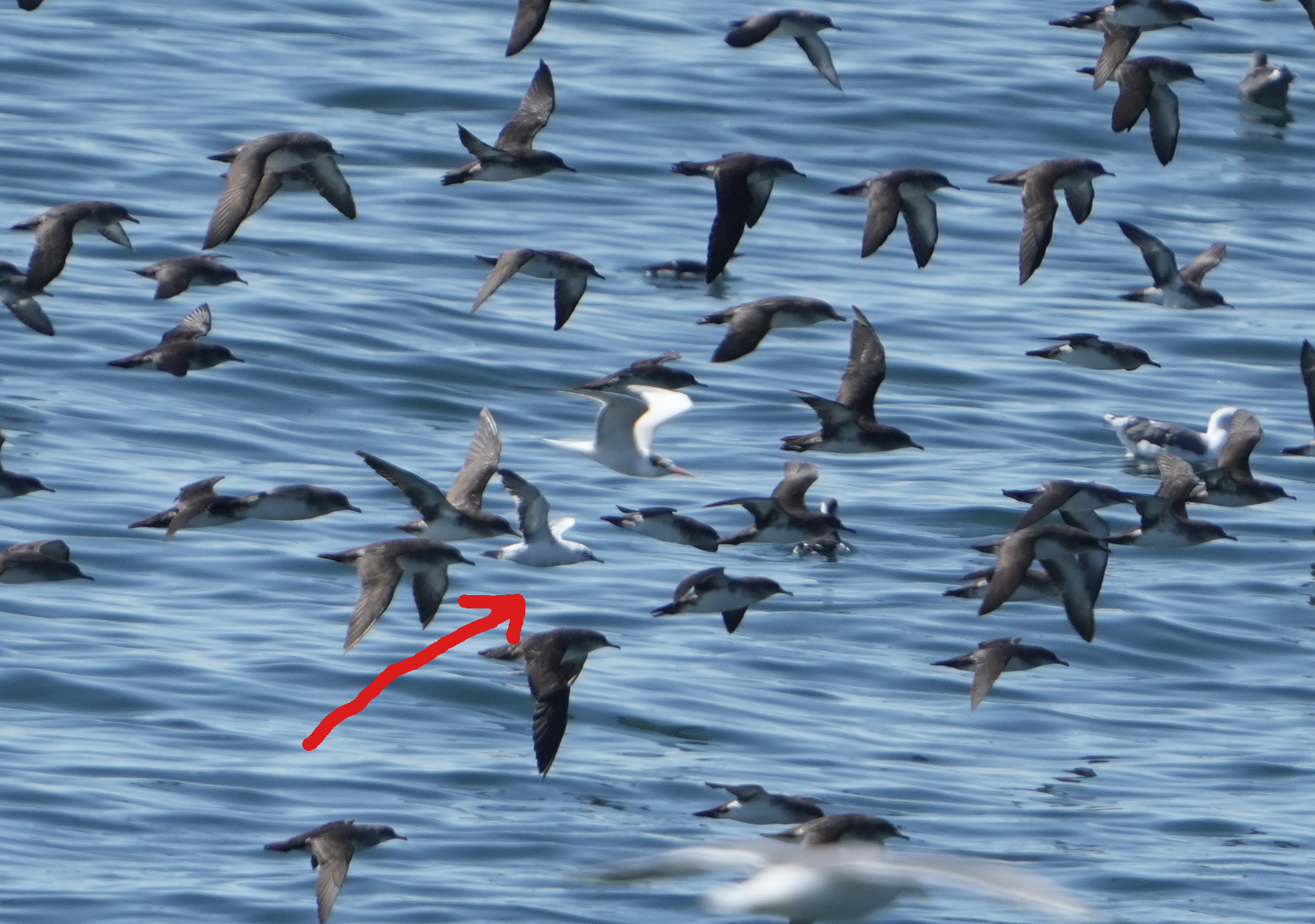
Hi birders,
Reviewing my bird images from the SC lighthouse today, I came across a
photo with what looks like a LEUCISTIC BLACK-VENTED SHEARWATER. Can't
say I've seen one of these before. Here is a crop of the frame in
question, with a red arrow pointing to the interesting bird, flying
below and to the left of the elegant tern:
"Everyone likes birds. What wild creature is more accessible to our eyes
and ears, as close to us and everyone in the world, as universal as a bird?"
- Sir David Attenborough
On Tue, Oct 6, 2026, 7:46 PM 'Pete Sole' via mbbirds <
<mbbirds...> wrote:
> Hi birders,
>
> Reviewing my bird images from the SC lighthouse today, I came across a
> photo with what looks like a LEUCISTIC BLACK-VENTED SHEARWATER. Can't
> say I've seen one of these before. Here is a crop of the frame in
> question, with a red arrow pointing to the interesting bird, flying
> below and to the left of the elegant tern:
>
>
> https://www.lighthousenet.com/photos/birds/documentary/shearwater_black_vented_leucistic_261006a.jpg >
> If somebody has a different opinion as to what this bird might be, or
> can confirm my ID suspicion, it would be great to read.
>
> Interesting birds out there...
>
> Pete Solé
>
>
> --
> You received this message because you are subscribed to the Google Groups
> "mbbirds" group.
> To unsubscribe from this group and stop receiving emails from it, send an
> email to mbbirds+<unsubscribe...>
> To view this discussion visit
> https://groups.google.com/d/msgid/mbbirds/<cec76ab9-9916-4561-beaf-aee3227f5bf3...> > .
>
Reviewing my bird images from the SC lighthouse today, I came across a
photo with what looks like a LEUCISTIC BLACK-VENTED SHEARWATER. Can't
say I've seen one of these before. Here is a crop of the frame in
question, with a red arrow pointing to the interesting bird, flying
below and to the left of the elegant tern:
I am seeing much the same thing being reported here at New Brighton SB.
Sooties, Black-vented, jaegers, gulls, pelicans, cormorants, etc. There are
also six humpback whales, a pod of bottlenose dolphins, two white sharks,
and multiple leopard sharks thrown in the mix. There is a lot happening
nearshore in the bay right now. The hardest part is to figure out where to
look.
Jim
On Tue, Oct 6, 2026, 4:12 PM 'Pete Sole' via mbbirds <
<mbbirds...> wrote:
> Hi birders,
>
> First, big thanks to Ryan, and all of the other birders that have been
> reporting on this amazing event, today (Tuesday Oct. 6, 2026).
>
> Around 11am I went over to the SC Lighthouse to catch some of it. Here is
> a large image that gives a very rough sense of what it looked like, when
> looking south from the lighthouse:
>
>
> https://www.lighthousenet.com/photos/birds/documentary/shearwaters_black_vented_and_more_261006b.jpg >
> Just an astonishing number of birds! The majority were Black-vented
> Shearwaters, Brand's Cormorants, Western and Heerman's Gulls, and Brown
> Pelicans. For more detail and photos see the ebird report at:
>
> https://ebird.org/checklist/S399827733 >
> My understanding from another birder, was that the anchovies were washing
> up on the western edge of Its Beach. Unfortunately, I ran out of time
> before I could get to the actual beach to take more photos.
>
> Pete Solé
>
> visiting from Soquel CA
>
>
>
> On 10/6/26 8:57 AM, Ryan Phillips wrote:
>
> Insane feeding Frenzy off Its Beach!!! Black-vented Shearwaters only 100
> feet out!
>
> *Ryan Phillips* ǀ Owner and Guide
>
> Personal and Group Birding Excursions in Northern California and Beyond
>
>
>
> Phone ǀ (831) 234-7324
>
> Email ǀ <norcalbirding...>
>
> Website ǀ *www.norcalbirding.com <http://www.norcalbirding.com/>* >
> Facebook ǀ www.facebook.com/norcalbirding
>
> "Everyone likes birds. What wild creature is more accessible to our eyes
> and ears, as close to us and everyone in the world, as universal as a bird?"
>
> - Sir David Attenborough
>
>
>
>
> --
> You received this message because you are subscribed to the Google Groups
> "mbbirds" group.
> To unsubscribe from this group and stop receiving emails from it, send an
> email to mbbirds+<unsubscribe...>
> To view this discussion visit
> https://groups.google.com/d/msgid/mbbirds/<CAGiyp6V6y6Mt3YHPhY_oAvNZdX_4WrdYS_Bb5N8GHzakjGrNfw...> > <https://groups.google.com/d/msgid/mbbirds/<CAGiyp6V6y6Mt3YHPhY_oAvNZdX_4WrdYS_Bb5N8GHzakjGrNfw...>?utm_medium=email&utm_source=footer> > .
>
>
> --
> You received this message because you are subscribed to the Google Groups
> "mbbirds" group.
> To unsubscribe from this group and stop receiving emails from it, send an
> email to mbbirds+<unsubscribe...>
> To view this discussion visit
> https://groups.google.com/d/msgid/mbbirds/<91c11171-7753-4ec8-a85c-b8db788a1080...> > <https://groups.google.com/d/msgid/mbbirds/<91c11171-7753-4ec8-a85c-b8db788a1080...>?utm_medium=email&utm_source=footer> > .
>
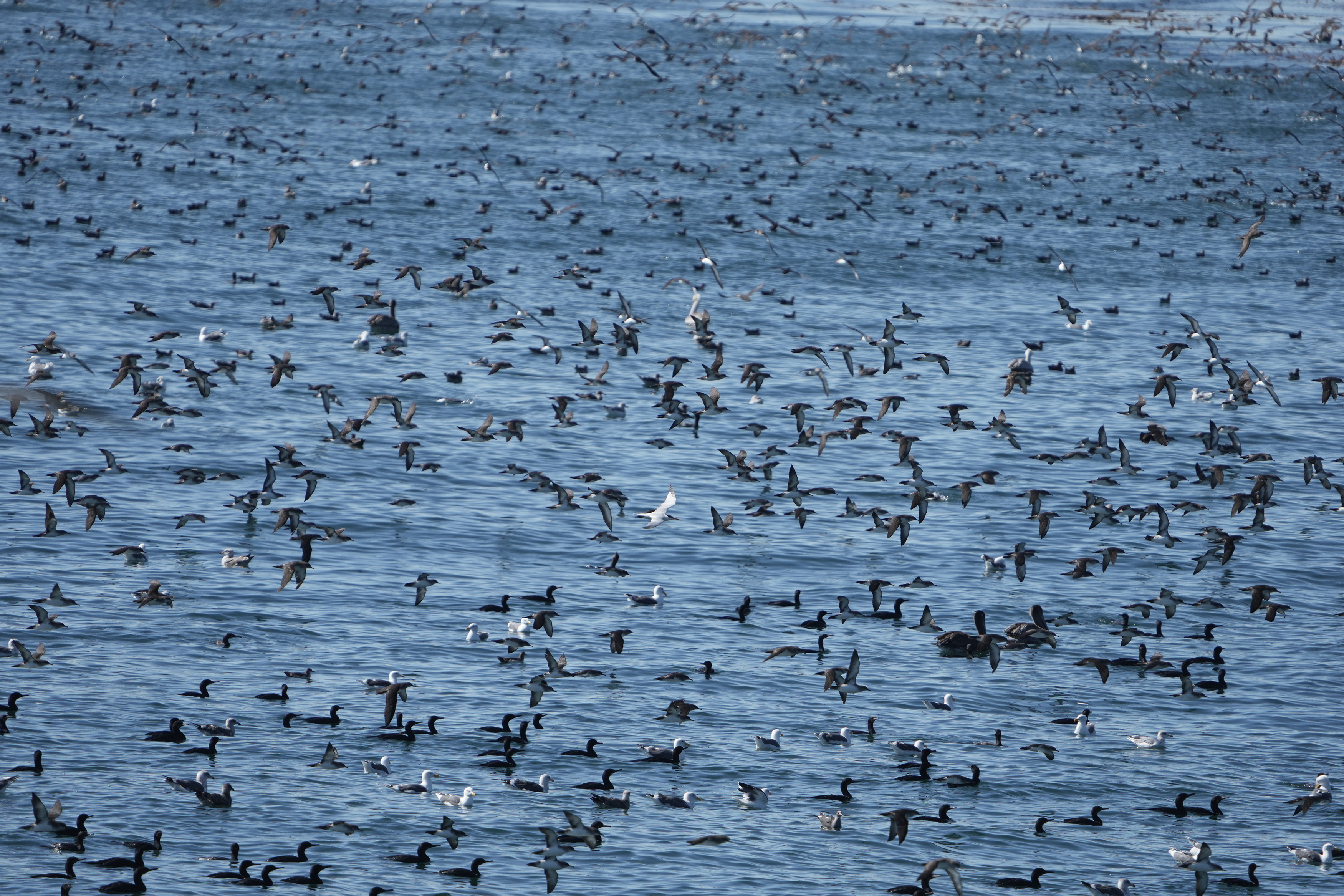
First, big thanks to Ryan, and all of the other birders that have been
reporting on this amazing event, today (Tuesday Oct. 6, 2026).
Around 11am I went over to the SC Lighthouse to catch some of it. Here
is a large image that gives a very rough sense of what it looked like,
when looking south from the lighthouse:
Just an astonishing number of birds! The majority were Black-vented
Shearwaters, Brand's Cormorants, Western and Heerman's Gulls, and Brown
Pelicans. For more detail and photos see the ebird report at:
My understanding from another birder, was that the anchovies were
washing up on the western edge of Its Beach. Unfortunately, I ran out of
time before I could get to the actual beach to take more photos.
Date: 10/6/26 1:10 pm From: 'Yahoo' via mbbirds <mbbirds...> Subject: [MBBIRDS] Hundreds of Cranes
I m just back to Santa Cruz having driven Saturday afternoon and this morning on Sandy Mush Road. Today about 0930 hundreds (I lost count at 250) of Sandhill Cranes in dairy field east of wildlife entrance adjacent to Sandy Mush Road. Flying in as I sat in car. Mid afternoon on Saturday a thousand ibis fed in a field just N of Merced Wildlife entrance. Today at 0900, 200 ibis east of rt 59 along Sandy Mush Road east of the big dairy.
Sent from Yahoo Mail for iPhone
--
You received this message because you are subscribed to the Google Groups "mbbirds" group.
To unsubscribe from this group and stop receiving emails from it, send an email to mbbirds+<unsubscribe...>
To view this discussion visit https://groups.google.com/d/msgid/mbbirds/<417236273.683238.1791317418967...>
Date: 10/3/26 10:59 am From: Nelson Samuels <samnelo...> Subject: [MBBIRDS] Matt McFaul posted pictures from Moss Landing of this Yellow-crowned Night Heron on the Nextdoor app this morning.
Sept 30 Hermit Thrush and Ruby-crowned Kinglet
Oct 1 Fox Sparrow and a Hermit Warbler that we got great looks at our bird bathWe have had several Golden-crowned sparrows for about a weekDown here on The Land in Royal Oaks, CAHappy Birding, Laura and Betty
Date: 9/28/26 5:13 pm From: Ryan Phillips <norcalbirding...> Subject: [MBBIRDS] SC Wharf BV Shearwaters and Jaegers
Lots of action off the end of the Santa Cruz Wharf. Scope needed. Multiple
jaegers (for sure one is Parasitic) chasing Elegant Terns and Black-vented
Shearwaters (at least 300, likely many more) in binocular range but a scope
helps.
*Ryan Phillips* ǀ Owner and Guide
Personal and Group Birding Excursions in Northern California and Beyond
A juvenile male rose-breasted grosbeak visited our yard last week, picking up seed off the ground and sampling the suet. This is a new yard bird for us.
Date: 9/28/26 11:17 am From: Matthew Coale <matthewcoale02...> Subject: [MBBIRDS] Spotted Sandpiper
Hi MBBers I saw what looks like a SPOTTED SANDPIPER at the harbor this morning at 11:00am. It was in fresh water from an inlet at the west side of the harbor near the railroad bridge. Best viewed from the railroad bridge looking west Matthew Coale Santa Cruz
Date: 9/24/26 5:31 pm From: 'Pete Sole' via mbbirds <mbbirds...> Subject: [MBBIRDS] Fox Sparrows at Loma Prieta
Hi birders,
Been meaning to write about the FOX SPARROWS at Loma Prieta for a couple
of days. I went to Loma Prieta on Tuesday Sept. 22nd and, as other
birders noted as well, there were many FOX SPARROWS. I conservatively
reported 7 individuals on my ebird checklist
<https://ebird.org/checklist/S395321875> for the morning, but there were
probably more.
Interestingly, a number of them were of the SLATE-COLORED subspecies,
including an individual that I was able to photograph. (Sadly the photos
are ahem, poor.)
Regardless, SLATE-COLORED FOX SPARROWS may be, a different species from
the SOOTY FOX SPARROW subspecies we more commonly see closer to the
coast. According to Cornell's Birds of the World reference site,
"analyses of mitochondrial DNA (mtDNA) detected significant amounts of
genetic structure, identifying 4 groups of Fox Sparrows corresponding to
those defined by plumage and morphology..". Cornell's site, lists 19
subspecies of Fox Sparrows, grouped into the 4 major groups; SOOTY,
THICK-BILLED, SLATE-COLORED, and RED. ( Source:
https://birdsoftheworld.org/bow/species/foxspa/cur/systematics )
What does this mean in plain English?
What our common reference books and apps mention as four subspecies of
Fox Sparrow, are actually groups of subspecies that may each be, a
separate species; SOOTY, THICK-BILLED, SLATE-COLORED, and RED.
Given the various contact points between the purported subspecies and
hybridization, ornithologists are still debating and collecting data.
Currently, some professional references already treat the four groups as
separate species. For example, the official International Ornithological
Committee (IOC), the predecessor to the International Ornithologists'
Union (IOU), lists the four Fox Sparrow groups as separate species. (To
see the IOC list, see this link:
This is a large searchable spreadsheet that may take time to load, even
on a fast internet connection.)
In any case, imho, it is worth it to try to list and document, the
separate Fox Sparrow subspecies that we can ID in the field. Who knows,
some day your report and photos may count as another species.
Fun birding,
Pete Solé
nerding out on bird speciation and migration in Soquel CA
Last weekend I was on the water guiding two full days of pelagic birding on
Monterey Bay. I am including highlights and links to the trip reports below.
Alvaro's Adventures Trip Report 9/19/26:
<https://ebird.org/tripreport/574413> We faced tough conditions, but made
it out to the canyon systems off Davenport and Año Nuevo. Highlights
included a pair of Craveri's Murrelets, an offshore Red-breasted Nuthatch,
several Parasitic and Pomarine Jaegers, a dozen Red Phalaropes, close looks
at an Arcitc Tern and Sabine's Gull, several Black-vented Shearwaters, and
an incredibly cooperative Guadalupe Fur Seal!
Monterey Seabirds Trip Report 9/20/26:
<https://ebird.org/tripreport/574677> Conditions
were a bit better than the previous day. We made it to similar waters, and
then followed the shelf edge all the way to Moss Landing. Highlights
included two Flesh-footed Shearwaters, a leucistic Sooty Shearwater, brief
looks at a couple of Short-tailed Shearwaters, incredible looks at a
Buller's Shearwater, South Polar Skua, dozens of Black Storm-petrels,
lunge-feeding Humpbacks, and Orcas (CA51s and CA50B)!
Pelagic season is still on with several more trips on Monterey Bay
with Monterey
Seabirds <https://www.montereyseabirds.com/> and a few more trips further
north out of Half Moon Bay and San Francisco with Alvaro's Adventures
<https://www.alvarosadventures.com/pelagic-dates-2026.html>. With this
year's warm water, who knows what might show up. Hope to see you on a boat
soon!
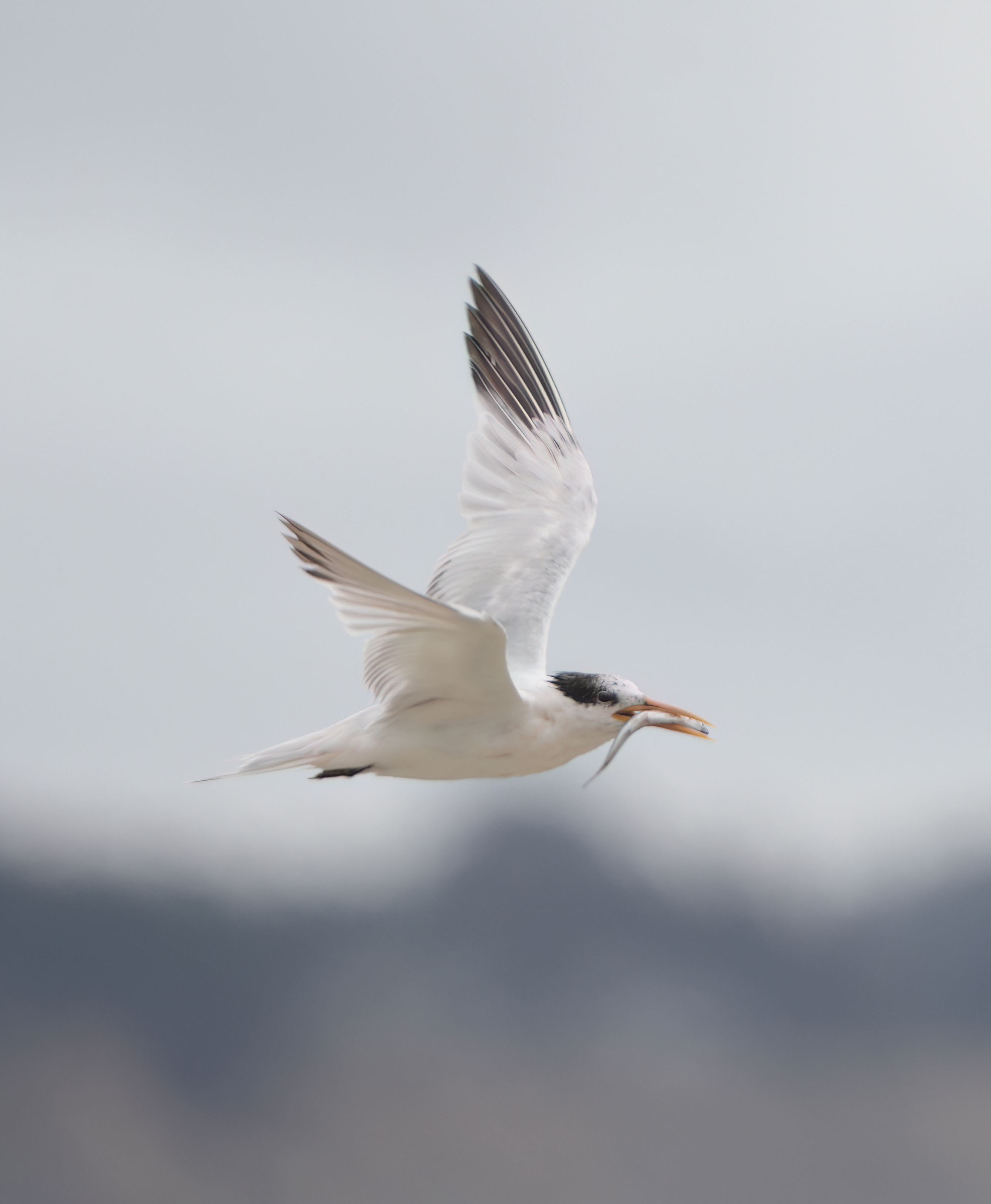
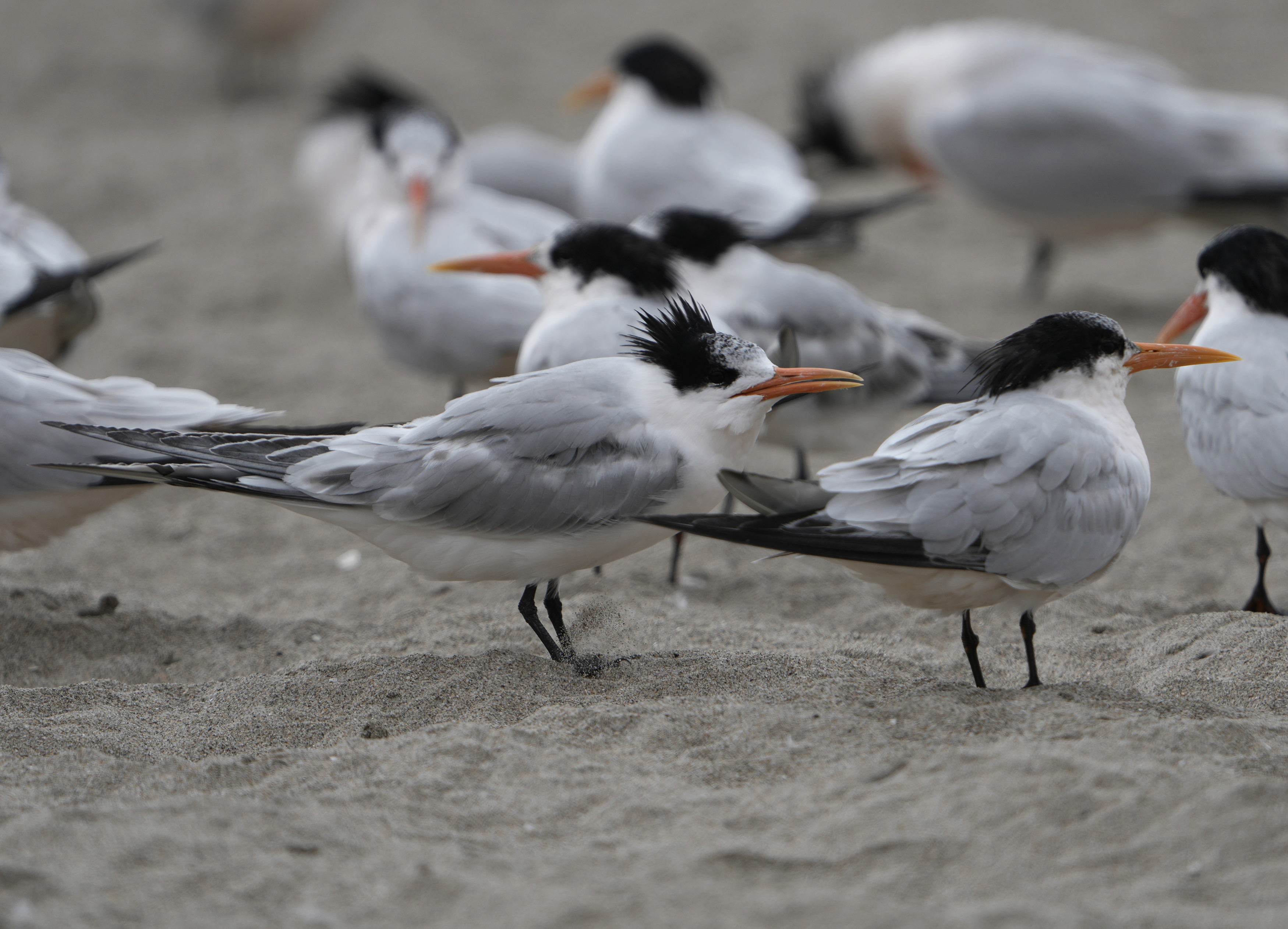
Date: 9/21/26 7:30 pm From: 'Pete Sole' via mbbirds <mbbirds...> Subject: [MBBIRDS] As the world terns...
Hi birders,
Just before lunch, went down to Aptos Creek Mouth for a purportedly
"short" look at the terns on the beach. The hope was to see a parasitic
jaeger for the season. Dipped on the jaeger, (probably too late in the
day), but there were hundreds (700+?) ELEGANT TERNS resting on the
beach. Among the many ELEGANTS, was also a FORSTER'S TERN and a COMMON
TERN. Some images:
I spent a few hours up at Fremont Peak this morning and found a CLARK’S NUTCRACKER. It was at the Coulter pine eBird hot spot. This is the first known record of a nutcracker at Fremont Peak.
All other San Benito County records of Clark’s Nutcrackers have been at San Benito Mountain except for one record at Pinnacles NP.
Date: 9/20/26 4:23 pm From: Lisa Larson <lisafaylarson...> Subject: [MBBIRDS] Not a Tropical Kingbird
Hi Birders,
Upon scrutiny of my crummy distant photos, I conclude that the king ird was Western, not Tropical. Apparent white outer tail feathers, cream upper chest with yellow belly, bill not heavy enough for TRKI.
But the Clay-colored Sparrows were sweet and it was great to see the return of the White-crowned Sparrows. Welcome back, sparrows!
Date: 9/20/26 11:13 am From: Ryan Phillips <norcalbirding...> Subject: [MBBIRDS] Clark's Nutcrackers Loma Prieta SCL Side
I posted this on South Bay Birds yesterday, but should have cross posted it
to MBB.
I had a flock of about 15 CLARK'S NUTCRACKERS on the Santa Clara side, but
right on the SCZ edge. They were flying north then went down behind ridge
line and lost view. I know folks are up looking today but wanted to give
coords. Really close to where the Lewis's Woodpecker was last year.
37.087952,-121.827024
Be wary and aware about the two gates that are labeled private road no
public access up there. The CLNU were seen well before that gate near
Knibbs Knob Trail.
Quite an irruption event happening! Get to your peaks with views.
Good birding,
Ryan
*Ryan Phillips* ǀ Owner and Guide
Personal and Group Birding Excursions in Northern California and Beyond
Date: 9/19/26 10:30 am From: liammsf <liammsf...> Subject: Re: [MBBIRDS] Be on the lookout
Adding to this, Santa Barbara has seen an irruption of Pinyon Jays as well,
following the nutcrackers. It would be wise to study up on the whole suite
of interior montane species, think Evening Grosbeak and Cassin's Finch as
well. Shaping up to be a very interesting and unique event!
Cheers,
Liam Murphy
On Sat, Sep 19, 2026, 10:21 AM Kent Johnson <kentjohnson...> wrote:
> Most of us who have been out birding recently have probably encountered
> multiple Red-breasted Nuthatches. Those of you who do not follow state-wide
> rare bird alerts may not be aware that there is another species erupting
> across California: Clark's Nutcracker. They have been seen in Santa
> Barbra, San Luis Obispo, Alameda, Contra Costa, San Francisco, and San
> Mateo Counties, and, this morning, at Loma Prieta on the Santa Clara County
> side. Higher elevations seem to be the best place to look for them, but
> they probably could show up almost anywhere.
>
> Kent Johnson
>
> --
> You received this message because you are subscribed to the Google Groups
> "mbbirds" group.
> To unsubscribe from this group and stop receiving emails from it, send an
> email to mbbirds+<unsubscribe...>
> To view this discussion visit
> https://groups.google.com/d/msgid/mbbirds/<BL1PPFCDE88AB435C97132B995CCFAFBE43AA862...> > <https://groups.google.com/d/msgid/mbbirds/<BL1PPFCDE88AB435C97132B995CCFAFBE43AA862...>?utm_medium=email&utm_source=footer> > .
>
Date: 9/19/26 10:21 am From: Kent Johnson <kentjohnson...> Subject: [MBBIRDS] Be on the lookout
Most of us who have been out birding recently have probably encountered multiple Red-breasted Nuthatches. Those of you who do not follow state-wide rare bird alerts may not be aware that there is another species erupting across California: Clark's Nutcracker. They have been seen in Santa Barbra, San Luis Obispo, Alameda, Contra Costa, San Francisco, and San Mateo Counties, and, this morning, at Loma Prieta on the Santa Clara County side. Higher elevations seem to be the best place to look for them, but they probably could show up almost anywhere.
Date: 9/19/26 9:29 am From: Suzanne Kent <surreykent...> Subject: [MBBIRDS] Westside SCruz Tanager update
Male all-red tanager observed again, perched on top of my suet feeder (watchful, not eating) then flew off into neighbor’s trees.
Plumage color is very consistent over entire bird, no evident grey cheek patch. So I identify it as Summer Tanager.
I would very much appreciate comments about color variation in this species, because of the sharp contrast between the duller red of this bird’s plumage compared to the intense tropical red and contrasting light-colored bill I observed in the past - at this same site, in late autumn or winter. I haven’t found description of Summer Tanager male winter plumage change, and this bird has none of the mixed yellow patches an immature male would have.
Date: 9/17/26 4:53 pm From: 'Pete Sole' via mbbirds <mbbirds...> Subject: [MBBIRDS] FOS and SC Migrants
Hi birders,
Not surprisingly, this last few weeks bird migration has really picked up.
A few highlights from today:
Near the Fern Grotto Beach on the Wilder Old Cove Trail, there was a
WESTERN KINGBIRD on a fence line. Then a WHITE-FACED IBIS flew along the
coast. This afternoon I had my first of season GOLDEN CROWNED SPARROW in
our garden. Meanwhile, I'm hearing almost every day now, a RED-BREASTED
NUTHATCH near our home.
Stepping back a bit, for more trend details see the the latest BirdCast
Migration Dashboard for SC county:
Date: 9/17/26 2:23 pm From: larry corridon <larry961357...> Subject: Re: [MBBIRDS] Possible Pectoral Sandpiper Pajaro Dunes Shore Bird Pond
I went to Shorebirds Pond about an hour ago and saw the Pectoral Sandpiper, (Thanks for the ID, Pete) and it was with another bird that to my eyes looked identical other than one slightly smaller than the other. I did not see the Solitary Sandpiper. The logistic redneck, fellow rope. (that is leucistic Red-Necked Phalarope, don't you love it when you're dictating?) was also present along with a semi-palmated Plover, 3 Mallards, 3 Snowy Egrets, and a few Greater Yellowlegs.
Larry Corridon
> 25, Deborah Diersch <debbiediersch...> wrote:
>
> Hi Pete,
>
> I saw that bird at Shorebirds yesterday afternoon, but couldn't positively ID it at the time. It was actively feeding with a Solitary Sandpiper. The leucistic Red-necked Phalarope was still there with several others of expected plumage. A surprise Black-necked Stilt flew in and there were many Greater Yellowlegs along with only two Mallards actively foraging in the shallow water and on the mudflats..
>
> Thank you for your reports and photos - it really helps!
> Debbie
>
> On Wed, Sep 16, 2026 at 5:37 PM 'Pete Sole' via mbbirds <mbbirds...> <mailto:<mbbirds...>> wrote:
>> Hi birders,
>>
>> Well, after reviewing a handful of pictures, I'm sticking with PECTORAL
>> SANDPIPER for the shore bird ID I reported earlier today. A few
>> processed, unfortunately backlit, and ahem, lets be generous and call
>> them documentary photos:
>>
>> https://www.lighthousenet.com/photos/birds/documentary/sandpiper_pectoral_260916a.jpg >>
>> https://www.lighthousenet.com/photos/birds/documentary/sandpiper_pectoral_260916c.jpg >>
>> In other news from Shorebird Ponds, the leuscistic Red-necked Phalarope
>> reported earlier continues, as well as other somewhat expected birds.
>> For more details and additional photos see the ebird report:
>>
>> https://ebird.org/checklist/S393488426 >>
>> Prior to going to Shorebird Ponds, I stopped off at Struve Slough at Lee
>> Road. The bid surprise there was a PACIFIC LOON. I was able to capture
>> some very distant, ahem, documentary images. Very surprised to see a
>> loon there. This was the first Pacific Loon I've ever seen there. For
>> more details and photos from Struve Slough see the ebird report at:
>>
>> https://ebird.org/checklist/S393464851 >>
>> Fun birding,
>>
>> Pete Solé
>> slowly editing bird pictures in Soquel, CA
>>
>>
>> On 9/16/26 12:11 PM, 'Pete Sole' via mbbirds wrote:
>> > Hi birders,
>> >
>> > Pretty sure I saw a possible Pectoral Sandpiper at Pajaro Dunes Shorebird Pond around noon today. I got photos which looked good on the back of the camera but will want to review this afternoon. Last seen flying, flushed by a low flying Turkey Vulture, towards the part of the pond near the entrance road.
>> >
>> > Pete Solé
>> >
>> >
>> > Sent from my iPhone
>> >
>>
>> --
>> You received this message because you are subscribed to the Google Groups "mbbirds" group.
>> To unsubscribe from this group and stop receiving emails from it, send an email to mbbirds+<unsubscribe...> <mailto:mbbirds%<2Bunsubscribe...>.
>> To view this discussion visit https://groups.google.com/d/msgid/mbbirds/<b878baeb-825b-4279-a5b8-48a4757b1835...> >
>
> --
> You received this message because you are subscribed to the Google Groups "mbbirds" group.
> To unsubscribe from this group and stop receiving emails from it, send an email to mbbirds+<unsubscribe...> <mailto:mbbirds+<unsubscribe...>.
> To view this discussion visit https://groups.google.com/d/msgid/mbbirds/CAFw6txXVA1%3Dj_rOqtS-Pe%3D6b-N%2BPD7PAw6hfzn0c0fiB1%<2BRVjw...> <https://groups.google.com/d/msgid/mbbirds/CAFw6txXVA1%3Dj_rOqtS-Pe%3D6b-N%2BPD7PAw6hfzn0c0fiB1%<2BRVjw...>?utm_medium=email&utm_source=footer>.
Date: 9/17/26 2:08 pm From: Suzanne Kent <surreykent...> Subject: [MBBIRDS] Possible male Hepatic Tanager in Westside Santa Cruz
First thing: There should NOT be a Hepatic Tanager in Santa Cruz - I know that!
What I observed: At approx. 1:30 PM today I checked out my ever-active suet feeder and observed a large tanager with the exact plumage coloration of a male Hepatic Tanager sitting on top of the feeder, in perfect light, in profile, starting to eat. It’s coloration was very evenly red, but a dull grayish red, with a dull grey-looking beak.
To my great frustration, a Scrub Jay on the nearby platform feeder flew at the tanager in a hostile manner, scaring it off. No chance to carefully look for the grey cheek that is an important ID sign. However, I have observed a male Summer Tanager, with its tropical red plumage and very light-colored bill, coming to the same feeder for four consecutive days one winter a couple of years ago. I also see Scarlet Tanagers each summer back East. Today’s Tanager was very notably more grayish red.
My suet feeder is hung on a pole only a few feet from an overgrown Coffeeberry covered with ripening berries.
Westsiders, please watch your yards and look for this bird.
Date: 9/17/26 11:25 am From: Deborah Diersch <debbiediersch...> Subject: Re: [MBBIRDS] Possible Pectoral Sandpiper Pajaro Dunes Shore Bird Pond
Hi Pete,
I saw that bird at Shorebirds yesterday afternoon, but couldn't positively
ID it at the time. It was actively feeding with a Solitary Sandpiper. The
leucistic Red-necked Phalarope was still there with several others of
expected plumage. A surprise Black-necked Stilt flew in and there were many
Greater Yellowlegs along with only two Mallards actively foraging in the
shallow water and on the mudflats..
Thank you for your reports and photos - it really helps!
Debbie
On Wed, Sep 16, 2026 at 5:37 PM 'Pete Sole' via mbbirds <
<mbbirds...> wrote:
> Hi birders,
>
> Well, after reviewing a handful of pictures, I'm sticking with PECTORAL
> SANDPIPER for the shore bird ID I reported earlier today. A few
> processed, unfortunately backlit, and ahem, lets be generous and call
> them documentary photos:
>
>
> https://www.lighthousenet.com/photos/birds/documentary/sandpiper_pectoral_260916a.jpg >
>
> https://www.lighthousenet.com/photos/birds/documentary/sandpiper_pectoral_260916c.jpg >
> In other news from Shorebird Ponds, the leuscistic Red-necked Phalarope
> reported earlier continues, as well as other somewhat expected birds.
> For more details and additional photos see the ebird report:
>
> https://ebird.org/checklist/S393488426 >
> Prior to going to Shorebird Ponds, I stopped off at Struve Slough at Lee
> Road. The bid surprise there was a PACIFIC LOON. I was able to capture
> some very distant, ahem, documentary images. Very surprised to see a
> loon there. This was the first Pacific Loon I've ever seen there. For
> more details and photos from Struve Slough see the ebird report at:
>
> https://ebird.org/checklist/S393464851 >
> Fun birding,
>
> Pete Solé
> slowly editing bird pictures in Soquel, CA
>
>
> On 9/16/26 12:11 PM, 'Pete Sole' via mbbirds wrote:
> > Hi birders,
> >
> > Pretty sure I saw a possible Pectoral Sandpiper at Pajaro Dunes
> Shorebird Pond around noon today. I got photos which looked good on the
> back of the camera but will want to review this afternoon. Last seen
> flying, flushed by a low flying Turkey Vulture, towards the part of the
> pond near the entrance road.
> >
> > Pete Solé
> >
> >
> > Sent from my iPhone
> >
>
> --
> You received this message because you are subscribed to the Google Groups
> "mbbirds" group.
> To unsubscribe from this group and stop receiving emails from it, send an
> email to mbbirds+<unsubscribe...>
> To view this discussion visit
> https://groups.google.com/d/msgid/mbbirds/<b878baeb-825b-4279-a5b8-48a4757b1835...> > .
>
Pete:
Oh that is undoubtedly a Pectoral Sandpiper. Bravo!
Shantanu
-----Original Message-----
From: 'Pete Sole' via mbbirds <mbbirds...>
Sent: Sep 16, 2026 5:37 PM
To: <mbbirds...>
Subject: Re: [MBBIRDS] Possible Pectoral Sandpiper Pajaro Dunes Shore Bird Pond
Hi birders,
Well, after reviewing a handful of pictures, I'm sticking with PECTORAL SANDPIPER for the shore bird ID I reported earlier today. A few processed, unfortunately backlit, and ahem, lets be generous and call them documentary photos:
In other news from Shorebird Ponds, the leuscistic Red-necked Phalarope reported earlier continues, as well as other somewhat expected birds. For more details and additional photos see the ebird report:
Prior to going to Shorebird Ponds, I stopped off at Struve Slough at Lee Road. The bid surprise there was a PACIFIC LOON. I was able to capture some very distant, ahem, documentary images. Very surprised to see a loon there. This was the first Pacific Loon I've ever seen there. For more details and photos from Struve Slough see the ebird report at:
Pete Solé
slowly editing bird pictures in Soquel, CA
On 9/16/26 12:11 PM, 'Pete Sole' via mbbirds wrote:
> Hi birders,
>
> Pretty sure I saw a possible Pectoral Sandpiper at Pajaro Dunes Shorebird Pond around noon today. I got photos which looked good on the back of the camera but will want to review this afternoon. Last seen flying, flushed by a low flying Turkey Vulture, towards the part of the pond near the entrance road.
>
> Pete Solé
>
>
> Sent from my iPhone
>
Well, after reviewing a handful of pictures, I'm sticking with PECTORAL
SANDPIPER for the shore bird ID I reported earlier today. A few
processed, unfortunately backlit, and ahem, lets be generous and call
them documentary photos:
In other news from Shorebird Ponds, the leuscistic Red-necked Phalarope
reported earlier continues, as well as other somewhat expected birds.
For more details and additional photos see the ebird report:
Prior to going to Shorebird Ponds, I stopped off at Struve Slough at Lee
Road. The bid surprise there was a PACIFIC LOON. I was able to capture
some very distant, ahem, documentary images. Very surprised to see a
loon there. This was the first Pacific Loon I've ever seen there. For
more details and photos from Struve Slough see the ebird report at:
Pete Solé
slowly editing bird pictures in Soquel, CA
On 9/16/26 12:11 PM, 'Pete Sole' via mbbirds wrote:
> Hi birders,
>
> Pretty sure I saw a possible Pectoral Sandpiper at Pajaro Dunes Shorebird Pond around noon today. I got photos which looked good on the back of the camera but will want to review this afternoon. Last seen flying, flushed by a low flying Turkey Vulture, towards the part of the pond near the entrance road.
>
> Pete Solé
>
>
> Sent from my iPhone
>
Date: 9/16/26 12:11 pm From: 'Pete Sole' via mbbirds <mbbirds...> Subject: [MBBIRDS] Possible Pectoral Sandpiper Pajaro Dunes Shore Bird Pond
Hi birders,
Pretty sure I saw a possible Pectoral Sandpiper at Pajaro Dunes Shorebird Pond around noon today. I got photos which looked good on the back of the camera but will want to review this afternoon. Last seen flying, flushed by a low flying Turkey Vulture, towards the part of the pond near the entrance road.
Date: 9/15/26 9:05 am From: Mary Anne Goldberg <mapmg2011...> Subject: Re: [MBBIRDS] FOS
I spied a red-breasted nuthatch at our fountain today in Royal Oaks, there for a moment before 16 or so lesser goldfinches mobbed it. Mary Anne
________________________________ From: silverbirder via mbbirds <mbbirds...> Sent: Monday, September 14, 2026 6:41 PM To: <mbbirds...> <mbbirds...> Subject: [MBBIRDS] FOS
Today we had the first of the season Gold-crown sparrow under our bird feeders. We have also had a Red-breasted nuthatch the last couple of days. Have not had one for over 20 years down here on The Land in Royal Oaks. Happy Birding, Laura and Betty
Today we had the first of the season Gold-crown sparrow under our bird feeders. We have also had a Red-breasted nuthatch the last couple of days. Have not had one for over 20 years down here on The Land in Royal Oaks.Happy Birding, Laura and Betty
--
You received this message because you are subscribed to the Google Groups "mbbirds" group.
To unsubscribe from this group and stop receiving emails from it, send an email to mbbirds+<unsubscribe...>
To view this discussion visit https://groups.google.com/d/msgid/mbbirds/<1051881815.18811.1789436489384...>
Date: 9/14/26 11:23 am From: Kent Johnson <kentjohnson...> Subject: [MBBIRDS] Possible Blackpoll Warbler Schwan Lake
I am about 75% sure on this. High in oaks on north side of gully that bisects the park. Clean buffy yellow on head and underparts, white bars on dark wings. Did not see back or feet. Kent Johnson
________________________________ From: <mbbirds...> <mbbirds...> on behalf of Stephanie Martin <martins4...> Sent: Tuesday, September 5, 2023 8:16 AM To: MBB <mbbirds...> Subject: [MBBIRDS] Eastern Kingbird at Wilder Ranch
Eastern Kingbird is presently flycatching in the chaparral beside Old Cove Landing trail at Wilder. At the mouth of the cove where the harbor seals haul out.
Date: 9/11/26 3:02 pm From: 'Lisa Sheridan' via mbbirds <mbbirds...> Subject: [MBBIRDS] Chat in Soquel
A yellow breasted Chat just showed up at my suet feeder and water fountain. ( confirmed by Alex). If you’re interested in viewing, please text me.
Lisa Sheridan, <Trotrider...>, 831-332-3785
--
You received this message because you are subscribed to the Google Groups "mbbirds" group.
To unsubscribe from this group and stop receiving emails from it, send an email to mbbirds+<unsubscribe...>
To view this discussion visit https://groups.google.com/d/msgid/mbbirds/<191981619.333318.1789164151688...>